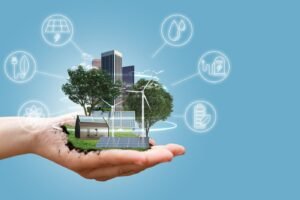
Artificial intelligence (AI) has become one of the most powerful tools for environmental change across industries worldwide. AI technology is transforming how businesses approach sustainability, from precision agriculture that uses less water to smart production systems that reduce waste. By combining machine learning, predictive analytics, and automated systems, companies can now use resources more efficiently than ever before while simultaneously reducing their environmental impact. As global businesses face increasing pressure to meet climate goals and implement sustainable practices, AI is helping to realise green innovations faster and more easily.
This technological revolution isn’t just improving the situation; it’s fundamentally changing how industries think about and conduct sustainable activities. Integrating AI and sustainability is a key strategy for achieving global environmental goals and driving economic growth. Understanding how AI is helping various sectors achieve sustainability reveals how this technology is transforming the world by making it greener and better.
AI in Agriculture:
Modern agriculture must simultaneously address two challenges: feeding a growing global population and minimising its environmental impact. AI-driven precision farming methods are transforming agricultural production, enabling better resource utilisation and reducing waste. Smart irrigation systems use machine learning algorithms to monitor soil moisture, weather conditions, and crop needs, then apply the right amount of water at the right time and in the right location. This precision irrigation method can save up to 30% of water while maintaining or even increasing crop yields.
Farmers can use computer vision technology to detect plant diseases, insect pests, and nutrient deficiencies early on. This prevents the spread of crop losses and reduces the use of chemical pesticides. Autonomous drones and satellite imagery with AI enable farmers to monitor the growth of large fields in real time, helping them decide whether to apply fertiliser, when to harvest, and how to manage their land. Together, these technologies reduce chemical runoff, improve soil health, and create a more sustainable food production system.
AI in Energy Management:
The energy sector is one of the most important sectors where AI contributes to sustainable development. Smart grid solutions use artificial intelligence (AI) to improve energy distribution efficiency, reduce transmission losses, and better connect renewable energy sources. Machine learning algorithms can predict energy consumption patterns with remarkable accuracy. This allows utilities to manage supply and demand while simultaneously reducing the use of fossil fuel backup systems.
AI-driven energy management systems in buildings and factories automatically adjust heating, cooling, and lighting based on occupancy, weather, and energy prices. These intelligent solutions can reduce energy consumption by 20% to 40% without compromising human comfort or productivity. Predictive maintenance algorithms analyse equipment health data to identify problems before they occur. This prevents energy waste and extends equipment lifespan.
AI in Manufacturing:
AI-driven optimisation of manufacturing processes is revolutionising the sustainability of the manufacturing industry. Manufacturers can reduce material waste by using predictive analytics to improve cutting patterns, production scheduling, and quality control processes. Machine learning algorithms analyse production data to identify problems and suggest ways to improve process efficiency, reducing energy and material consumption.
AI-driven smart manufacturing systems can automatically adjust production settings in real time, reducing environmental impact without compromising product quality. These systems utilise every aspect of the process, from material flow and equipment usage to temperature and pressure settings. With digital twins based on artificial intelligence (AI), manufacturers can test and refine production processes before they go live, reducing the time-consuming and labour-intensive trial-and-error process.
AI in Transportation:
Transportation contributes significantly to global greenhouse gas emissions, making this sector a key focus for AI-based sustainability solutions. Route optimisation algorithms can plan optimal delivery routes based on traffic patterns, weather conditions, and vehicle capacity, enabling logistics organisations to reduce fuel consumption and pollution. These solutions can reduce transportation emissions by 15% to 25% while simultaneously shortening delivery times and improving customer satisfaction.
Autonomous vehicle technology is expected to offer additional environmental benefits, such as improved driver safety, reduced traffic congestion, and optimised car-sharing systems. Smart cities are using AI-driven traffic management systems to coordinate traffic lights, manage parking, and improve the efficiency of public transportation, helping to reduce overall urban transport emissions. Electric vehicle charging networks utilise AI to optimise charging schedules based on power demand and the availability of renewable energy.
AI in Waste Management:
AI technology is helping to address the growing environmental challenge of waste management by exploring new methods for waste separation, recycling, and waste reduction. Computer vision systems based on machine learning can locate and sort different types of waste faster and more accurately than human operators. These automated sorting systems help recycle more materials and keep recyclable material streams cleaner.
Waste management companies can use predictive analytics to determine optimal collection routes, reduce fuel consumption, and prevent environmentally damaging flooding. Equipped with sensors and AI algorithms, smart trash bins can monitor their fullness and detect any contamination. This helps improve waste stream management and develop more efficient collection plans. AI systems can also help identify ways to reduce waste and initiate circular economy projects by observing how waste is generated and how materials flow.
Conclusion:
Integrating AI into sustainability efforts is more than just a technological advancement; it marks a significant shift in data-driven environmental management. As AI technologies become more advanced and accessible, their ability to drive sustainable development across all sectors will only increase. AI is more than just a tool for increasing efficiency; it is also a catalyst for significant environmental change, as demonstrated by successful examples in agriculture, energy, manufacturing, transportation, and waste management. Companies that embrace AI-driven sustainability initiatives are at the forefront of both technological advancement and environmental responsibility. To benefit both the environment and the economy in the future, it is necessary to apply AI technologies intelligently and strike a balance between the two. As we move forward, it will be crucial to continue developing and leveraging AI for sustainable development to address global environmental challenges and promote economic growth and societal progress.
FAQs:
1. How can AI reduce carbon emissions in different sectors?
AI reduces carbon emissions in several ways, such as by improving energy efficiency, increasing operational efficiency, and enabling better resource allocation. Machine learning algorithms can identify problems in real time and automatically adjust systems to reduce energy consumption. Companies can switch to renewable energy more easily with the help of predictive analytics.
2. What are the primary challenges in using AI in environmental projects?
Key issues include high startup costs, the need for technical expertise, data quality and availability, and preventing AI systems from consuming excessive energy. Organisations also need to address the challenges of integrating new systems with older ones. They also need to convince their staff, who are used to older methods, to adopt these changes.
3. Can AI-driven sustainability solutions help small businesses?
Yes, small businesses can access AI-driven sustainability solutions through cloud platforms, software-as-a-service (SaaS), and partnerships with IT companies. Many AI tools are now available to help small businesses save energy, reduce waste, and improve process efficiency. These technologies are affordable and accessible, making them very useful for small businesses.
4. How can we understand how AI systems impact the environment?
Measuring the environmental impact of AI systems requires metrics such as energy consumption during model training and deployment, the carbon footprint of data centres, and lifecycle analyses of AI hardware. Companies are developing green AI strategies that focus on algorithms with lower energy consumption and computer systems with longer lifespans.
5. How can AI help companies comply with regulations and achieve their environmental goals?
AI can automatically track and report environmental data, allowing companies to operate more efficiently to achieve their efficiency goals and plan for long-term growth. These technologies also help companies comply with environmental regulations by monitoring emissions, waste, and resource usage in real time.